


May 10, 2026
| By Mark Rayant
The Architecture of Belonging
Modern society is more interconnected than ever, yet human connection is weakening. Rebuilding peoplehood through shared values, purpose, and real-world connection may be the path forward.
Never in human history have people been more interconnected than they are today. Advances in digital and telecommunications technologies have brought the world together at an unprecedented scale in just the past few decades–digitally, economically, socially, and globally.
Despite this, in societies worldwide and especially in communities that prioritize pluralism, cohesion is weakening. At astonishing levels and in many aspects of life–in politics, media, civic trust, social life, and identity formation generally–polarization, distrust, and fragmentation are growing. Pluralistic societies are especially vulnerable because they contain more visible cultural differences and require stronger shared norms to hold together . Technology has brought us together faster than our natural social evolution can account for.
In striving for innovation and advancement we have built systems that connect the world, but not systems that connect people.
The chart below visualizes the increasing scale of human organization, and with it the changing nature of connection.
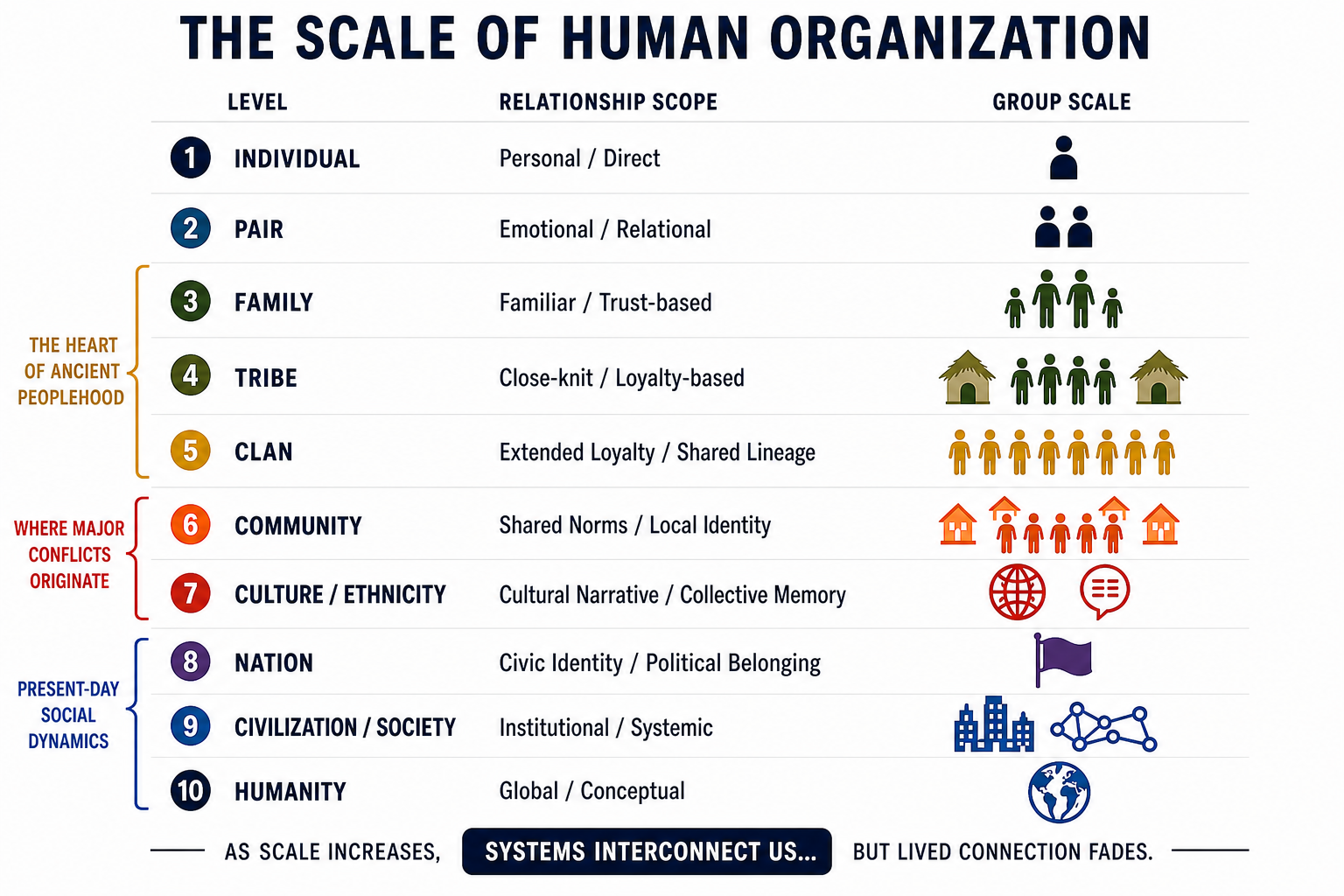
Human organization is like a ladder, where each rung can be roughly split into the levels depicted above. In small groups, emotional bonding and interpersonal connection are the dominant forces. As the scale of human social organization increases, the impulse towards that emotional bonding remains, but the mechanism of connection behaves differently.
At the base level, and most importantly, is the individual and the relationship to the self. Understanding ourselves and growing our identity is the bedrock of all social systems. The next most basic levels of organization are the pair and family units. Here connection and deep personal bonds–with one’s partner and closest kin–build trust, understanding, loyalty, and shared identity. These bonds enable personal development, cooperation, and survival.
The next levels, from tribe to culture and ethnicity, frame who we are within the greater context of the world. This includes our language, cuisine, shared history, rituals, and inherited norms. At smaller scales these relationships outline how we act within the domain of our immediate community, and at larger scales, they define our value system and worldview. A shared cultural background allows us to establish deep connections with people we have never before interacted with, and extends our relationships across geographic boundaries.
At the highest level are scales of human connection that have existed for just a brief moment of human history. The idea of the modern nation-state, an organizational system outside of monarchy or ethnic delineations, began to take form around the 18th century. In the 19th and 20th centuries, improvements in navigation (ships, railroad, automobiles, and aviation) brought together at an international scale different civilizations participating for the first time in a worldwide economy.
The 21st century world–with instantaneous communications, large-scale population movements, and worldwide interdependent supply chains–is defined by humanity’s reach into a global community that encompasses all people.
The key issue here is that scale changes the nature of emotional connection. This is because familiarity decreases or is constructed artificially within increasingly large groups. The more people we add to our networks, the less personal the majority of our relationships become. Familiarity becomes more associated with causes and ideologies than with connections between people.
With the rise of online interaction, emotional signals and the associated bonds are increasingly easy to manipulate. Passions and sentiments still dominate our interactions, but identity as a concept becomes abstract and vulnerable to manipulation. In today's world, a mechanism evolved to bind small groups together has been repurposed to divide large populations.
As technology expands the reach of our voices, amplification can become deeply problematic. Ideologues and institutions are able to exploit the increased reach and speed of communication to engineer psychological responses. Emotional reactions, especially fear, outrage, and a sense of belonging, become weaponized. People are driven towards causes and away from each other.
The more complex and interconnected our networks become, the more vulnerable human connection becomes to emotional manipulation by actors who seek to divide for personal gain.
Humanity stands apart from other forms of life on Earth not due to our intelligence, upright posture, use of tools, or even our complex communication as some would suggest. Many other species possess some variation of these gifts. Humanity’s ability to shape the environment, advance civilization, and transform the world to fit our needs stems directly from our nature as a uniquely social species.
Large-scale organization allows for the ideas of one to extend to an entire people. Through this strength we have collectively moved mountains. We have traversed impassable terrain, ventured into the cosmos, and reinvented ourselves time and time again. Extending from one person, collective vision is our unique power as a species.
For most of human history, peoplehood existed in the middle layers: tribes, clans, and early communities numbering in the tens to hundreds. People were bound together by shared belief systems–often spiritual in nature. We were joined by a common purpose of survival, continuity, and legacy. Within these groups existed a strong sense of norms and mutual accountability, with identity rooted in relationships and responsibility.
This formed the basis of human connection. Repeated interaction created trust and recognition. While differences existed, they were bounded within a shared framework. Once we scaled beyond these structures, the mechanisms that originally held us together no longer functioned the same way.
In a worldwide social system, organization often takes place via ideological vectors: worldviews, movements, institutions, stories, and identities that carry meaning across large populations. These are powerful frameworks that serve to bind people together. They have the power to unify, but also to divide.
Large-scale conflict most often originates above the middle layers, between communities and cultures. Even wars between nation states are frequently rooted in competing value systems and in borders that divide populations with distinct identities, beliefs, and ways of life. Commonality is often found most strongly through the creation of opposition, when a sense of peoplehood is constructed against an ‘other’ who takes the role of the outsider or the enemy.
It is no surprise then that public support for leadership frequently occurs just after the outset of a national crisis or external conflict. Politicians base their campaigns around vilifying and attacking their opponents. Professional sports teams see their highest turnouts when facing traditional rivals. Hate movements draw crowds by calling for the destruction or removal of minority groups. Few things bind groups together as powerfully as the belief that they are defeating a shared enemy. Many movements today are centered around the creation of enemies through the vilification of groups of people. Ironically, it is the things that bind us strongly that often tear us apart.
In the modern world, we retain micro-level connections with family, friends, and communities while operating in macro-level systems without a common framework for belonging. When emotional bonding is redirected away from shared humanity and towards shared difference, conflict is almost unavoidable.
At the scale of the present day, peoplehood can no longer be defined as something that is purely inherited or ancestral. It cannot be something that is entirely self-selected, nor can it be reduced to self-selected affinity silos.
Peoplehood must evolve to become something more intrinsic to all humans, rooted in needs and values that precede ideology, rather than something that defines smaller groups or ideological subsets. It must be a flexible framework rooted in shared values, capable of operating across scale and difference. Modern peoplehood is the state of belonging extended to encompass all of humanity. Within this framework, shared identity, culture, and destiny are created through the common purpose of establishing a better future.
This is not about diminishing our diversity or eliminating conflict. Distinct religions, political affiliations, cultures, and value systems are real and enduring, and tensions between groups will always exist. Our goal must be to create a structure that prioritizes coexistence and cooperation despite disagreement. When people join together to align objectives for common good, healthy conflicts strengthen society by revealing productive disagreements and exposing malignant worldviews. Difference can become a source of learning rather than a pretext for conflict.
Behind what separates us, there exist certain fundamental truths for all people. We want to be known. We want to be loved. We want our lives to matter. We gather around families, friendships, rituals, causes, nations, faiths, and shared stories because they give shape to our lives. We grieve, hope, forgive, strive, and sacrifice. We are wounded by exclusion and restored by connection. Beneath every difference, we remain creatures of longing: for dignity, purpose, and belonging.
A global community does not require agreement, but rather a shared foundation that can hold disagreement without collapse. Our destinies are inextricably intertwined. It is not too late to build that foundation together, but the work must begin before the forces of division pull us apart—and it starts with the individual.
What originates at a single unit can extend to billions. There is no top-down structure or power that can be imposed on the world to make it a more just place. It is up to each and every one of us to embody the righteousness we hope to see in the world, and by example to teach the next generations to do the same.
Belief in a higher power and a shared destiny, beyond the self, imbues us with a sense of purpose and meaning. This can take the form of faith, moral truth, or transcendent principles. Whether it is rooted in religion, science, or the underlying order of the universe, belief in something greater is consistently linked to higher levels of happiness and life satisfaction.
Commit to work–at any scale–that extends beyond personal gain. The bedrock of shared identity is purpose, intentionality, and humility.
Historical and archaeological evidence reveals that, for much of recorded history, human societies have existed in a near-constant state of conflict. Fighting is the easier route. It entices us with the idea of gain without compromise or sacrifice. Waging peace through building community is difficult. It is a painful, vulnerable process and offers little reward in the short term. Yet, humanity’s greatest achievements have come through collaboration.
Constructing understanding is a deliberate practice that requires effort and intent. Actively search for common ground across differences. Prioritize real human relationships, including with those who possess different worldviews. Look for the best in others, and in the process expose the best within yourself.
We are surrounded by systems of instant gratification. We are sold the idea that through social media platforms, consumerism, or status culture we can purchase or perform our way out of our problems without effort.
The online world has introduced a culture where the self is celebrated above all else, and where worth is measured relative to the curated appearances of others. We can escape the toxic cycle by resisting systems that reward self-promotion, outrage, and division.
Move away from treating identity as performance and validation as currency. Build your value around who you are as a person and the good you contribute to this world, not how you appear to others. Self-promotional platforms like social media leave us feeling hollow and cut off. We never feel more connected than when working together to make the world a better place. Present who you are through service to the common good, not through how you wish to be seen.
Another paradox of the interconnected age is that people are incentivized to withdraw into themselves. Why venture out into the world to build community when it takes less energy to be involved online? We have evolved over millions of years to read facial expressions, body language, and social cues. Nearly all of this is lost online, where intent and meaning are often flattened and distorted and anonymity allows for unchecked hate.
Introduce yourself to your neighbors, smile at people walking down the street, and join a local group, volunteer organization, faith community, or club. When you experience a difference of opinion, always begin by assuming good intentions where possible. No one is fully defined by a single belief or point of view. If you condemn people before understanding why they think the way they do, you’ll never discover where you agree. Listen deeply to gain understanding without interjecting your perspective, and find a like-minded person behind different ideas.
This is a pivotal moment in human history. How we proceed as a global community will define humanity for centuries to come.
The world is not going to become simpler. Networks will continue to expand, people will become more interconnected, and differences will persist. We can choose whether the systems we create divide us, or whether we use them to build something that binds us together in our shared destiny. Societies may argue endlessly over values, but there are areas of deep human agreement that can be uncovered through sustained contact, dialogue, and shared purpose. Discovering where we agree is the only viable path to a peaceful future. The work starts with you: rebuilding the architecture of belonging one relationship at a time.
Mark Rayant is the Co-Founder and COO of Otanu, a platform designed to rebuild human connection through civil, face-to-face conversation. His work focuses on belonging, social cohesion, technology, and the future of community. Learn more about Mark.

